
What Should You Know Before Choosing a Career in Dental?
September 14, 2026
How Long Are Dental Residencies? A Complete Guide
September 15, 2026
Yes, dentists can have residency after dental school, but not every dentist is required to complete a residency before practicing general dentistry in the United States. The answer depends on the type of dentist, the state where the dentist wants to practice, and whether the dentist plans to become a dental specialist.
After completing a Doctor of Dental Surgery (DDS) or Doctor of Dental Medicine (DMD) degree, a new dentist may be able to meet the requirements for a general dental license without completing a traditional multi-year residency. However, dentists who want to specialize in areas such as orthodontics, oral surgery, pediatric dentistry, endodontics, periodontics, or prosthodontics generally need additional postgraduate education through an accredited dental residency program.
This is one of the main differences between dentistry and medicine. Medical doctors usually complete residency training after medical school as a standard part of becoming an independently practicing physician. Dentistry has a different educational structure. A general dentist can often begin a professional career after dental school and the required licensing process, while specialty dentists usually continue into residency training.
Understanding how dental residency works can help students, patients, and anyone considering a career in dentistry understand the education and training required to become a dentist in the United States.
Do Dentists Have Residency?
Yes, dentists have residency programs, but residency is not mandatory for every dentist.
A general dentist may complete dental school, pass the required licensing examinations, meet state requirements, and begin practicing without completing a separate residency. Some new dentists still choose to complete a postgraduate general dentistry residency because it can provide more clinical experience and training.
Dental residency becomes particularly important for dentists who want to specialize. Specialty programs provide advanced education in a specific area of dentistry and usually take additional years after dental school.

For example, an orthodontist receives advanced training in moving teeth and correcting bite problems. An oral and maxillofacial surgeon receives extensive training in surgical procedures involving the mouth, jaw, and related facial structures.
Also read:What Should You Know Before Choosing a Career in Dental?
So, the simple answer is:
A dentist does not always need residency to practice general dentistry, but many dental specialists need residency or another approved postgraduate training program.
What Is a Dental Residency?
A dental residency is postgraduate clinical training completed after dental school.
During dental school, students learn the foundations of dentistry and gain supervised clinical experience. Residency allows dentists to continue developing their skills in a more focused professional environment.
Residents generally work with patients while receiving supervision from experienced dentists and specialists. Depending on the program, they may treat patients in hospitals, dental clinics, community health centers, or specialty practices.
Dental residency can involve:
- Advanced patient care
- Diagnosis and treatment planning
- Complex dental procedures
- Emergency dental care
- Hospital-based dentistry
- Specialized clinical training
- Collaboration with other healthcare professionals
- Professional development
- Case discussions and academic learning
The exact experience depends on the type of residency.
Is Dental Residency Required for Every Dentist?
No.
This is one of the most important points to understand when asking, “do dentists have residency?”
General dentistry and dental specialties have different training pathways.
A person who wants to become a general dentist may not need to complete a postgraduate residency after earning a DDS or DMD. However, the dentist must still satisfy the licensing requirements of the state where they want to practice.
A dentist who wants to become a specialist generally needs additional education and clinical training.
This means dental residency is not a universal requirement in the same way that residency is generally expected for physicians after medical school.
Do General Dentists Have Residency?
General dentists can complete residency, but they do not always have to.
After dental school, some graduates enter private practices, group practices, community clinics, public health programs, or other dental settings.
Others choose a postgraduate program such as a General Practice Residency (GPR) or Advanced Education in General Dentistry (AEGD).
These programs can be valuable for dentists who want additional clinical experience before entering independent practice.
A new dentist may choose residency because they want more confidence with complex cases, exposure to hospital dentistry, experience treating medically complex patients, or additional training in areas that were only briefly covered in dental school.
What Is a General Practice Residency?
A General Practice Residency, commonly called a GPR, is a postgraduate dental training program designed to provide advanced clinical experience in general dentistry.
GPR programs often involve a combination of dentistry and hospital-based care.
Residents may treat patients with more complicated medical conditions and may work alongside physicians, nurses, pharmacists, and other healthcare professionals.
The experience can be especially useful for dentists interested in hospital dentistry or caring for patients with complex medical needs.
A GPR generally lasts about one year, although some programs offer additional training.
The exact structure, clinical experience, and requirements vary by program.
What Is an AEGD?
AEGD stands for Advanced Education in General Dentistry.
An AEGD is another type of postgraduate dental education for dentists who want additional training in general dentistry.
Like a GPR, an AEGD can help a new dentist build clinical skills after dental school.
The main focus is generally advanced general dental care rather than training for a specific dental specialty.
AEGD programs can provide experience with more complex procedures, comprehensive treatment planning, and different patient populations.
Some programs may also offer opportunities for research, teaching, or community dentistry.
GPR vs. AEGD
GPR and AEGD programs are both postgraduate options, but they can have different educational environments.
| Feature | GPR | AEGD |
| Full name | General Practice Residency | Advanced Education in General Dentistry |
| Main focus | Advanced general dentistry with strong clinical training | Advanced general dental education |
| Hospital exposure | Often significant | Usually less hospital-focused |
| Medically complex patients | Common in many programs | Depends on the program |
| Typical length | Often 1 year | Often 1 year |
| Best suited for | Dentists interested in advanced or hospital-based care | Dentists wanting more general clinical experience |
The actual experience can vary considerably between individual programs, so applicants should research the curriculum rather than choosing based only on the program name.
How Long Is Dental Residency?
The length of dental residency depends on the type of program.
A general practice residency or AEGD is commonly about one year, although some programs can provide longer training.
Dental specialty programs usually take more time.
Examples include:
- Orthodontics: commonly about 2 to 3 years
- Pediatric dentistry: commonly about 2 years
- Endodontics: commonly about 2 to 3 years
- Periodontics: commonly about 3 years
- Prosthodontics: commonly about 3 years
- Oral and maxillofacial surgery: commonly 4 to 6 years, depending on the program
- Dental anesthesiology: commonly about 3 years
These are general ranges rather than universal rules. Individual programs can have different lengths and structures.
Why Do Dentists Go Through Residency?
There are several reasons a dentist may choose residency.
The first is additional clinical experience.
Dental school provides extensive education, but a new graduate may want more supervised experience before handling certain complex cases independently.
The second reason is specialization.
A dentist who wants to become an orthodontist, endodontist, periodontist, or another recognized specialist generally needs additional postgraduate education.
The third reason is exposure to different patient populations.
Residency can allow dentists to treat children, older adults, patients with complex medical conditions, emergency cases, and patients who may not have easy access to routine dental care.
The fourth reason is professional development.
Residency can help dentists improve treatment planning, clinical judgment, communication, and teamwork.
What Happens During Dental Residency?
Dental residency is usually a combination of clinical work and education.
Residents spend significant time treating patients under supervision.
They may also attend lectures, seminars, case conferences, and other educational sessions.
Depending on the program, residents may participate in:
- Patient examinations
- Treatment planning
- Restorative dentistry
- Oral surgery
- Emergency care
- Root canal treatment
- Prosthodontic treatment
- Periodontal care
- Pediatric dental care
- Hospital consultations
- Interdisciplinary treatment
The exact responsibilities depend on the program and the resident’s level of training.
Do Dental Residents Get Paid?
Many dental residency programs provide a stipend or salary, but the amount and benefits vary.
Dental residency is different from dental school because residents are postgraduate trainees who often provide patient care as part of their training.
Some programs may provide benefits such as health insurance, paid leave, or other employment-related benefits.
However, compensation varies significantly between programs.
Students should always check the current information published by the specific residency program when comparing opportunities.
Do Dentists Go to Residency Like Doctors?
Dentists can complete residency just as physicians do, but the role of residency is different.
Medical doctors generally complete residency after medical school before practicing independently in their chosen field.
Dentists have more than one pathway.
A general dentist can often enter practice after completing dental school and the required licensing process. A dentist who wants advanced postgraduate training can complete a GPR or AEGD. A dentist who wants to become a specialist usually completes an appropriate advanced specialty program.
Therefore, saying that “dentists do residency just like doctors” is not completely accurate.
Both professions use postgraduate clinical training, but their educational systems are structured differently.
Do Dentists Need Residency to Get Licensed?
Usually, completing a residency is not a universal requirement for a general dental license in the United States.
Dental licensure requirements are established by individual states and can include education, examinations, clinical requirements, background checks, and other conditions.
Because requirements vary by state, dental students should check the licensing rules for the state where they plan to practice.
Specialty certification and general dental licensure are also separate issues.
A dentist can be licensed as a general dentist without necessarily being trained as a dental specialist.
Dental School vs. Dental Residency
Dental school and residency serve different purposes.
Dental school provides the foundational education needed to become a dentist.
Students learn subjects such as anatomy, physiology, pathology, pharmacology, oral biology, dental materials, diagnosis, prevention, and clinical dentistry.
Residency comes afterward.
It provides more focused postgraduate experience and can help dentists develop advanced clinical skills.
A simple way to understand the difference is:
Dental school teaches you how to become a dentist.
Residency helps you develop additional clinical skills or prepare for a specialty.
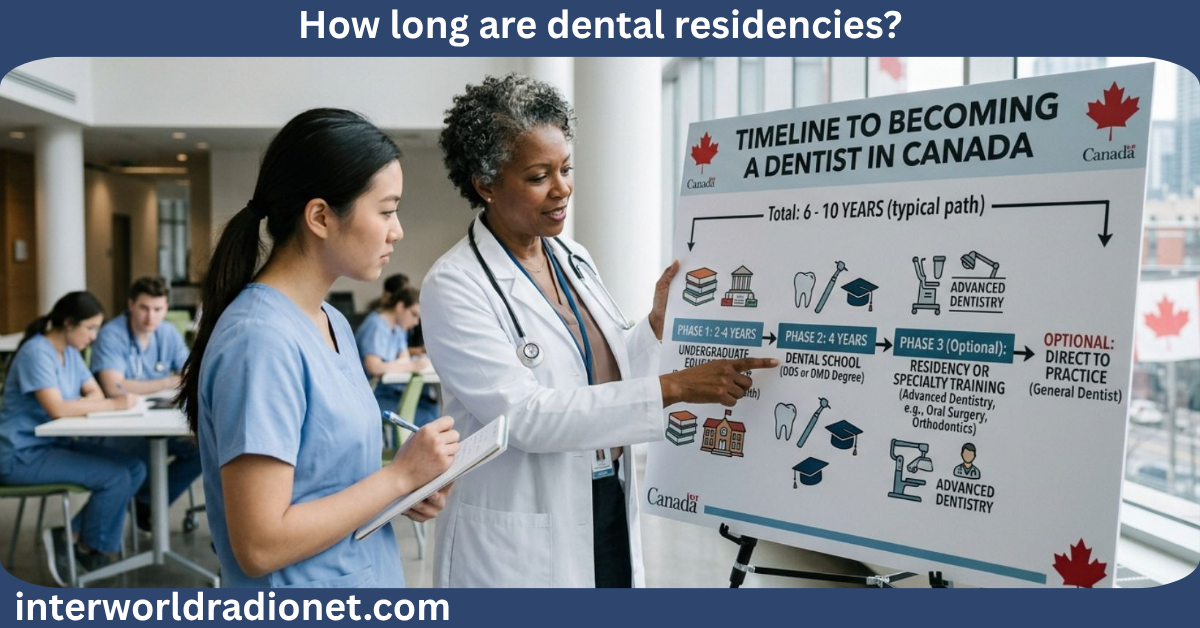
How Long Does It Take to Become a Dentist?
The total timeline varies, but becoming a dentist in the United States generally requires several stages of education.
Students typically complete undergraduate education before entering dental school.
Dental school commonly takes four years.
After dental school, a person can pursue licensure and enter general dental practice if they meet the applicable state requirements.
If the person chooses residency, another year or more may be added.
Specialty training can add two to six or more years depending on the specialty and program.
This means someone who wants to become a specialist will spend substantially more time in formal education and training than someone who enters general dentistry.
Do All Dental Specialists Have Residency?
Dental specialties have different educational requirements.
In the United States, recognized dental specialties generally require advanced education beyond the basic dental degree.
Examples of dental specialties include:
- Endodontics
- Orthodontics and dentofacial orthopedics
- Pediatric dentistry
- Periodontics
- Prosthodontics
- Oral and maxillofacial surgery
- Oral and maxillofacial pathology
- Oral and maxillofacial radiology
- Dental anesthesiology
- Oral medicine
- Orofacial pain
- Dental public health
The specific educational pathway depends on the specialty.
Specialty programs provide focused education in the diagnosis, treatment, and management of conditions within that field.
Do Orthodontists Have Residency?
Yes.
Orthodontists complete additional postgraduate education after dental school.
Orthodontic residency focuses on tooth movement, bite relationships, jaw development, growth, and related treatment planning.
Orthodontists learn how to evaluate patients and design treatment plans involving braces, clear aligners, retainers, and other orthodontic approaches.
Because orthodontics requires specialized knowledge and clinical skills, dentists who want to become orthodontists generally complete an accredited advanced education program in orthodontics.
Do Oral Surgeons Have Residency?
Yes.
Oral and maxillofacial surgery requires extensive postgraduate training.
Oral and maxillofacial surgeons receive advanced education in surgical procedures involving the mouth, jaw, face, and related structures.
Training can include areas such as:
- Tooth extractions
- Impacted teeth
- Jaw surgery
- Facial trauma
- Oral pathology
- Anesthesia
- Surgical treatment planning
Some oral and maxillofacial surgery programs are particularly long because of the broad range of surgical and medical training involved.
Do Pediatric Dentists Have Residency?
Yes.
Pediatric dentists complete additional postgraduate training focused on the dental care of infants, children, teenagers, and patients with special healthcare needs.
Pediatric dentistry residency can cover growth and development, preventive dentistry, behavior guidance, restorative care, dental trauma, and other areas related to young patients.
Working with children requires more than simply knowing dental procedures.
Dentists also need communication skills that help young patients feel comfortable and cooperate with treatment.
Do Endodontists Have Residency?
Yes.
Endodontists receive specialized postgraduate education focused on diseases and injuries affecting the dental pulp and tissues around the roots of teeth.
Root canal treatment is one of the best-known procedures associated with endodontics.
Endodontic training also includes diagnosis of tooth pain, complex root canal procedures, and other treatments involving the inside of the tooth.
Do Periodontists Have Residency?
Yes.
Periodontists complete advanced training focused on the gums and supporting structures around teeth.
Their education can involve periodontal disease, gum treatment, dental implants, bone-related procedures, and the management of tissues supporting the teeth.
Periodontology requires a detailed understanding of both oral biology and clinical treatment.
Do Prosthodontists Have Residency?
Yes.
Prosthodontists complete additional postgraduate education focused on restoring and replacing teeth.
Their training may involve:
- Crowns
- Bridges
- Dentures
- Dental implants
- Complex restorative treatment
- Full-mouth rehabilitation
Prosthodontics often involves complex treatment planning because multiple teeth and oral structures may need to be considered together.
What Is the Difference Between a Dental Residency and Fellowship?
A residency is usually a structured postgraduate clinical training program.

A fellowship is generally additional focused training after or during advanced professional education.
Also read:Is Dental Hygiene Considered a Professional Degree or a Healthcare Degree?
The exact meaning of “fellowship” can vary by institution and specialty.
For someone researching dental careers, it is important not to assume that a fellowship is always equivalent to a residency.
The program’s curriculum, accreditation, clinical responsibilities, and purpose provide a better indication of the training involved.
Are Dental Residents Fully Licensed Dentists?
Dental residents generally have dental degrees and participate in postgraduate clinical training under the rules and supervision established by their programs and jurisdictions.
The exact licensing or permit arrangement can vary depending on the state, institution, and residency structure.
This is why residents may provide patient care but still work under program-specific supervision and policies.
A dental resident is not the same as a dental student.
A resident has already completed dental school and is receiving postgraduate training.
Do Dental Residents Treat Real Patients?
Yes.
Clinical patient care is an important part of most dental residency programs.
Residents gain experience by examining and treating real patients while receiving appropriate supervision.
This allows them to develop clinical judgment and technical skills in real-world situations.
The level of independence increases as residents gain experience and demonstrate competency.
Is Dental Residency Difficult?
Dental residency can be challenging.
Residents may have long clinical days, complex cases, academic responsibilities, and demanding schedules.
The difficulty also depends on the type of program.
A hospital-based residency may involve emergency cases and medically complex patients.
A specialty program may involve advanced procedures and detailed treatment planning.
Residents must balance patient care with learning and professional responsibilities.
However, many dentists choose residency because the additional experience can be valuable for their long-term careers.
What Skills Do Dentists Develop During Residency?
Residency can help dentists develop several important skills.
Clinical judgment is one of the most important.
A resident learns not only how to perform procedures but also how to decide which treatment is appropriate.
Communication is another major skill.
Dentists need to explain diagnoses, treatment options, risks, benefits, and expected outcomes in language patients can understand.
Residents may also develop:
- Time management
- Emergency management
- Treatment planning
- Teamwork
- Patient communication
- Clinical confidence
- Professional judgment
- Documentation skills
- Interdisciplinary communication
These skills can remain valuable throughout a dental career.
What Is Hospital Dentistry?
Hospital dentistry involves providing dental care in a hospital environment.
This can be especially important for patients with complex medical conditions or those who require care that is difficult to provide in a standard dental office.
A GPR can provide significant hospital-based experience.
Dentists may work with medical teams to coordinate patient care.
This can help residents understand how oral health connects with broader healthcare.
Why Is Hospital Experience Valuable for Dentists?
Oral health does not exist separately from the rest of the body.
Some patients have medical conditions that affect dental treatment.
Certain medications can affect oral health. Some dental procedures may require special planning for patients with complex medical histories.
Hospital-based training can expose dentists to these situations.
It can also improve their ability to communicate with physicians and other healthcare professionals.
Can a Dentist Become a Specialist Without Residency?
In the United States, becoming a recognized dental specialist generally requires advanced education in the specialty.
The exact requirements depend on the specialty and applicable accreditation and certification pathways.
Simply calling yourself a specialist without completing the appropriate education does not provide the same professional training as completing an accredited specialty program.
Patients who want specialty care can ask a dentist about their education, training, and credentials.
How Do Dental Residency Applications Work?
Dental residency applications can be competitive.
Applicants typically provide information about their dental education, academic record, clinical experience, recommendations, personal statement, and other qualifications.
Some programs may use centralized application systems, while requirements can vary.
Applicants should review the current requirements of each program because application systems and policies can change.
What Do Dental Residency Programs Look For?
Programs may consider several factors.
Academic performance can be important, but it is not the only factor.
Programs may also look at clinical experience, communication skills, recommendations, leadership, research, community involvement, and the applicant’s interest in the program.
For specialty residency, programs may pay close attention to the applicant’s preparation and interest in the specific specialty.
Is Dental Residency Competitive?
Some dental residency programs are highly competitive.
Competition can be particularly strong for popular specialties and programs with limited positions.
Applicants can improve their preparation by gaining strong clinical experience, building professional relationships, maintaining good academic performance, and understanding what each program values.
Competition does not mean every dentist needs residency.
It mainly matters for dentists who want postgraduate training or specialization.
Does Residency Make a Dentist Better?
Residency can provide valuable additional training, but completing residency does not automatically mean that one dentist is better than another.
A general dentist who did not complete residency can still provide excellent patient care.
Likewise, a specialist who completed advanced training has developed specific expertise in a particular field.
The most important issue is whether the dentist has appropriate education, licensure, experience, clinical competence, and a commitment to patient care.
What Should Patients Know About Dental Residency?
Patients may encounter dentists who are completing residency training.
Residents are already dental graduates and are receiving additional clinical education.
They generally treat patients under supervision according to the policies and requirements of their program.
For patients, residency clinics can sometimes provide access to advanced or lower-cost care, depending on the institution.
However, treatment availability, fees, waiting times, and eligibility vary between programs.
Are Dental Residency Clinics Cheaper?
Some residency clinics may offer treatment at reduced fees compared with private dental practices.
This can happen because the clinic is part of an educational institution or training program.
Also read:What Dentists Wish You Knew About Your Oral Health?
However, prices vary significantly.
Patients should ask about the cost, treatment timeline, supervising dentist, and payment policies before beginning treatment.
Lower cost does not necessarily mean lower quality, but patients should understand that appointments may take longer because treatment is part of an educational environment.
Dental Residency and Patient Safety
Patient safety is an important part of postgraduate dental education.
Residents work under program rules designed to provide appropriate supervision and clinical care.
Programs typically use treatment planning, documentation, infection-control procedures, and supervision to support safe patient care.
Patients should feel comfortable asking questions about who will perform the procedure and who supervises the treatment.
Good communication is an important part of safe dental care.
How Is Dental Residency Different From Medical Residency?
The biggest difference is when residency is needed.
For physicians, residency is normally a required stage of postgraduate training for practicing independently in a medical specialty.
For dentists, general practice does not universally require a separate residency after dental school.
Dental residency is especially important for advanced general dentistry and specialty training.
This difference is one reason people sometimes become confused when they compare dentists and doctors.
Do Dentists Have Residency During Dental School?
Usually, dental residency happens after dental school rather than during it.
Dental students do complete extensive clinical training while earning their DDS or DMD.
However, residency is postgraduate education.
A person first completes the dental degree and then may enter a residency program.
There are also different advanced training programs, so students should understand whether a particular opportunity is part of the dental degree or postgraduate education.
Can You Become a Dentist Without Residency?
Yes, in many U.S. situations, a person can become a general dentist without completing a separate residency.
The person still needs to complete an accredited dental education and satisfy applicable licensing requirements.
The pathway is different for people who want to specialize.
This is why the answer to “do dentists have residency?” depends strongly on the career goal.
Is Residency Worth It for a General Dentist?
There is no single answer.
For some graduates, residency provides valuable additional experience.
A new dentist who feels they need more clinical confidence may benefit from an AEGD or GPR.
A dentist interested in hospital dentistry or medically complex patients may find GPR particularly useful.
Another dentist may prefer to begin working immediately in general practice.
Both paths can lead to successful dental careers.
The best choice depends on the individual’s career goals, financial situation, learning needs, and preferred practice environment.
Advantages of Dental Residency
Dental residency can provide several benefits.
Residents can gain additional clinical experience while working with experienced supervisors.
They may encounter more complex cases than they would typically see during dental school.
Residency can also improve treatment planning and clinical decision-making.
For specialty applicants, postgraduate residency is an essential part of becoming qualified in their chosen field.
Another advantage is professional networking.
Residents work with dentists, specialists, physicians, and other healthcare professionals who may become valuable professional contacts.
Possible Disadvantages of Dental Residency
Residency also has disadvantages.
The biggest is time.
A dentist may spend another year or several years in postgraduate education instead of entering full-time practice.
Income can also be lower than what an established dentist may earn in private practice, depending on the residency stipend and local opportunities.
Residency can also be demanding.
Therefore, students should consider both the educational benefits and the personal and financial costs.
What Comes After Dental Residency?
After completing residency, a dentist may enter a private practice, group practice, hospital, academic institution, public health organization, or another professional setting.
Specialists may work in specialty practices or multidisciplinary healthcare environments.
Some dentists also pursue teaching, research, leadership, or additional advanced education.
The career possibilities depend on the type of training completed.
Does Residency Increase a Dentist’s Salary?
Residency itself does not guarantee a higher salary.
However, advanced training can influence career opportunities.
Specialists often have different career paths and compensation structures from general dentists.
Income also depends on location, experience, practice ownership, specialty, patient volume, employment model, and many other factors.
Students should therefore avoid choosing a specialty based only on expected income.
Dental Residency and Career Planning
For students considering dentistry, it is useful to think about residency early.
Ask yourself what kind of dentist you want to become.
If you want general practice, residency may be optional.
If you want to become an orthodontist, endodontist, periodontist, pediatric dentist, prosthodontist, or oral and maxillofacial surgeon, you should expect additional postgraduate training.
Knowing this early can help you plan your education, finances, applications, and career goals.
How to Choose a Dental Residency Program
Students comparing programs should look at more than the program name.
Consider:
- Curriculum
- Clinical volume
- Types of patients
- Faculty experience
- Hospital exposure
- Specialty rotations
- Technology
- Location
- Compensation
- Benefits
- Program culture
- Accreditation
- Career outcomes
Talking with current or former residents can also provide useful insight into the real experience.
Questions to Ask a Dental Residency Program
Before applying, students can ask:
What types of patients do residents treat?
How much clinical experience does the program provide?
How much hospital training is included?
What procedures are residents expected to perform?
How are residents supervised?
What is the typical schedule?
What benefits are provided?
What are the program’s accreditation details?
What do graduates typically do after completion?
These questions can help applicants compare programs more effectively.
Final Thoughts
So, do dentists have residency?
Yes, dentists can have residency, but not every dentist is required to complete one. In the United States, a person pursuing general dentistry can often complete dental school, satisfy state licensing requirements, and begin practicing without a separate residency. However, many dentists choose postgraduate training through a General Practice Residency or Advanced Education in General Dentistry program to gain additional clinical experience.
Residency becomes especially important for dentists who want to specialize. Fields such as orthodontics, endodontics, periodontics, pediatric dentistry, prosthodontics, and oral and maxillofacial surgery require advanced education beyond the basic dental degree.
The key difference is that dental residency is not a universal requirement for general dentists. It is an important pathway for advanced training and specialization. Whether residency is the right choice depends on the dentist’s career goals, desired clinical experience, specialty interests, and professional plans.
For students considering dentistry, understanding this distinction early can make the education and career path much easier to plan.
Frequently Asked Questions About Dental Residency
Can international dentists complete residency in the United States?
Yes, some international dental graduates can apply to U.S. postgraduate dental programs, but eligibility requirements vary by program and state. International applicants may need to complete additional education, examinations, credential evaluations, or other requirements before they can enter certain programs or practice.
Can dental residents prescribe medications?
Dental residents may prescribe medications when permitted by their professional license, training program, and applicable laws. The medications and circumstances depend on the resident’s scope of practice and the type of patient care involved.
Do dental residents work weekends and nights?
Some residency programs include weekend, evening, or emergency responsibilities. The schedule depends on the program. Hospital-based programs and programs with emergency dental services may have more demanding schedules than some outpatient programs.
Can dentists teach after completing residency?
Yes. Dentists with postgraduate training can pursue teaching and academic careers. Some work as clinical instructors, lecturers, faculty members, researchers, or program educators. Academic opportunities depend on the institution and the dentist’s qualifications.
Can a dentist complete more than one residency?
It is possible for a dentist to complete additional postgraduate programs, although doing so requires significant additional time and commitment. A dentist might complete general postgraduate training and later pursue specialty education or another advanced program depending on career goals.